
GLS644 Visible Light Sensitive Dye – 644nm Absorption and 674nm Fluorescence Emission

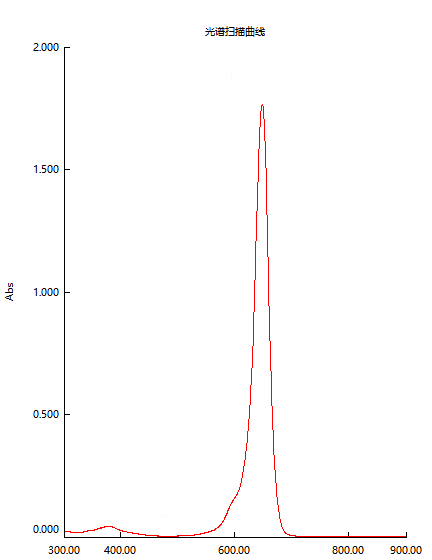
GLS644 is a cyanine dye with a sharp absorption peak at 644nm and an estimated fluorescence emission peak at approximately 674nm. It belongs to the red-absorbing cyanine dye family and shares optical characteristics with widely referenced dyes in the Cy5 range.
The dye responds selectively to red light in the 620–660nm range and shows negligible absorption below 580nm. This selectivity makes it suitable for applications requiring a defined red-light response, including visible light photosensitization, fluorescence-based detection, optical filtering and photochemistry research.
GLS644 is supplied as a green crystalline powder with good solubility in methylene chloride and other common organic solvents.
Typical Specifications
Absorption peak: 644±2nm
Appearance: Green crystalline powder
Estimated emission peak:Approximately 674nm
Stokes shift:Approximately 30nm
Absorption range:Approximately 600–670nm
UV and blue-green absorption:Negligible below 580nm
Peak molar absorptivity: High — consistent with cyanine dye class
Solubility: Soluble in MC
Note: The emission peak value is an estimate based on the measured absorption data and known photophysical behavior of structurally related cyanine dyes. Independent fluorescence spectroscopy measurement under defined solvent and concentration conditions is recommended before use in quantitative fluorescence applications.

How GLS644 Works
GLS644 absorbs red light at 644nm and transitions to an excited singlet state. Depending on the application and surrounding chemical environment, this excited state can follow different pathways:
Fluorescence emission
In solution, GLS644 can release absorbed energy as fluorescence, emitting at approximately 674nm. This makes it detectable using standard red-channel optical filters and instrumentation compatible with Cy5-range dyes.
Photoinduced electron transfer
In the presence of a suitable electron acceptor such as an iodonium salt, GLS644 in its excited state can undergo photoinduced electron transfer. This generates reactive radical or ionic species capable of initiating polymerization.
Energy transfer
GLS644 may also function as an energy donor in sensitizer systems, transferring excitation energy to a co-sensitizer or reactive intermediate.
The dominant pathway depends on the formulation, solvent, co-initiator type and concentration.
Applications
GLS644 is suitable for applications requiring selective red-light absorption at 644nm or red-range fluorescence detection at approximately 674nm.
Visible Light Photopolymerization
GLS644 acts as a photosensitizer in visible light photoinitiator systems for radical polymerization of acrylate and methacrylate resins.
Upon red-light irradiation at 644nm, GLS644 enters an excited state and undergoes electron transfer with a co-initiator such as a diaryliodonium salt, generating radicals that initiate polymerization. An amine co-initiator may be added as a third component to improve overall efficiency.
Typical applications include:
- Red-LED-activated light-curable coatings
- Visible-light-curable adhesives
- 3D printing resins for red-light systems
- Photocurable films and laminates
- Dental material research formulations
A co-initiator is required. GLS644 does not initiate polymerization independently.
Fluorescence Labeling and Detection
With an absorption peak at 644nm and an estimated emission peak at approximately 674nm, GLS644 falls within the Cy5 spectral range. It is compatible with Cy5-channel filter sets used in standard fluorescence instrumentation.
Potential research applications include:
- Fluorescence microscopy
- Flow cytometry
- Microplate fluorescence assays
- Lateral flow assay development
- Nucleic acid and protein detection research
Bioconjugation suitability depends on the available reactive functional groups in the GLS644 structure. Technical documentation should be requested before evaluation in biological labeling workflows.
Photodynamic Research
The 644nm absorption falls within the tissue optical window, where light penetrates biological tissue more effectively than UV or shorter visible wavelengths. Cyanine dyes in this spectral range have been investigated in photodynamic research contexts.
GLS644 may be evaluated for:
- Singlet oxygen generation studies
- Photodynamic inactivation of microorganisms
- Reactive oxygen species research
- Cancer cell photosensitization studies
Singlet oxygen quantum yield has not been independently confirmed for GLS644. Researchers should conduct independent photophysical characterization before use in cell-based or in vivo studies.
Optical Filtering and Laser Attenuation
The narrow absorption band at 644nm allows GLS644 to selectively attenuate red-range light with minimal interference at other wavelengths.
Suitable uses include:
- Absorption filters for 638nm and 650nm diode lasers
- Laser safety eyewear lens formulation research
- Notch filters for laboratory optical systems
- Spectrally selective coatings
Security Printing and Spectral Authentication
GLS644 absorbs selectively in the red range and is not visually prominent under standard white-light viewing conditions, making it suitable for covert or machine-readable marking systems.
Potential uses include:
- Red-light-readable security inks
- Spectral authentication markers
- Covert document and product marking
Frequently Asked Questions (FAQ)
What light sources are compatible with GLS644?
GLS644 is designed for activation by red light in the 620–660nm range. Optimal excitation is at 644nm. Compatible sources include 638nm and 650nm diode lasers and red LEDs with emission centered in this range. GLS644 does not respond efficiently to UV, blue or green light.
Does GLS644 fluoresce?
Yes. GLS644 is a fluorescent cyanine dye. Based on the measured absorption peak and the known photophysical behavior of cyanine dyes, the fluorescence emission peak is estimated at approximately 674nm. Independent measurement under defined conditions is recommended before use in quantitative fluorescence work.
Does GLS644 require a co-initiator for photopolymerization?
Yes. GLS644 functions as a photosensitizer and requires an electron acceptor such as a diaryliodonium salt to generate initiating radicals. A three-component system including an amine co-initiator may improve efficiency depending on the resin and light source.
What is the difference between a photosensitizer and a photoinitiator?
A Type I photoinitiator cleaves directly upon light absorption to generate radicals. A photosensitizer such as GLS644 absorbs light and transfers energy or electrons to a co-initiator, which then generates the reactive species. Photosensitizers generally offer greater flexibility in wavelength selection but require a compatible co-initiator.
Can GLS644 be used for biological labeling?
GLS644 may be evaluated for fluorescence labeling in research settings. Suitability for bioconjugation depends on the molecular structure and available reactive groups. GLS644 is not evaluated or approved for clinical diagnostic use. Please request technical documentation and conduct independent assessment before use in biological systems.
Is GLS644 approved for food-contact applications?
No. GLS644 is intended for industrial and research use only.
How should GLS644 be stored?
Store in a sealed opaque container at cool and dry conditions, protected from light, heat and moisture. Refer to the safety data sheet for complete storage and handling requirements.